Why Are Aussies More Miserable Now Than in Lockdown?
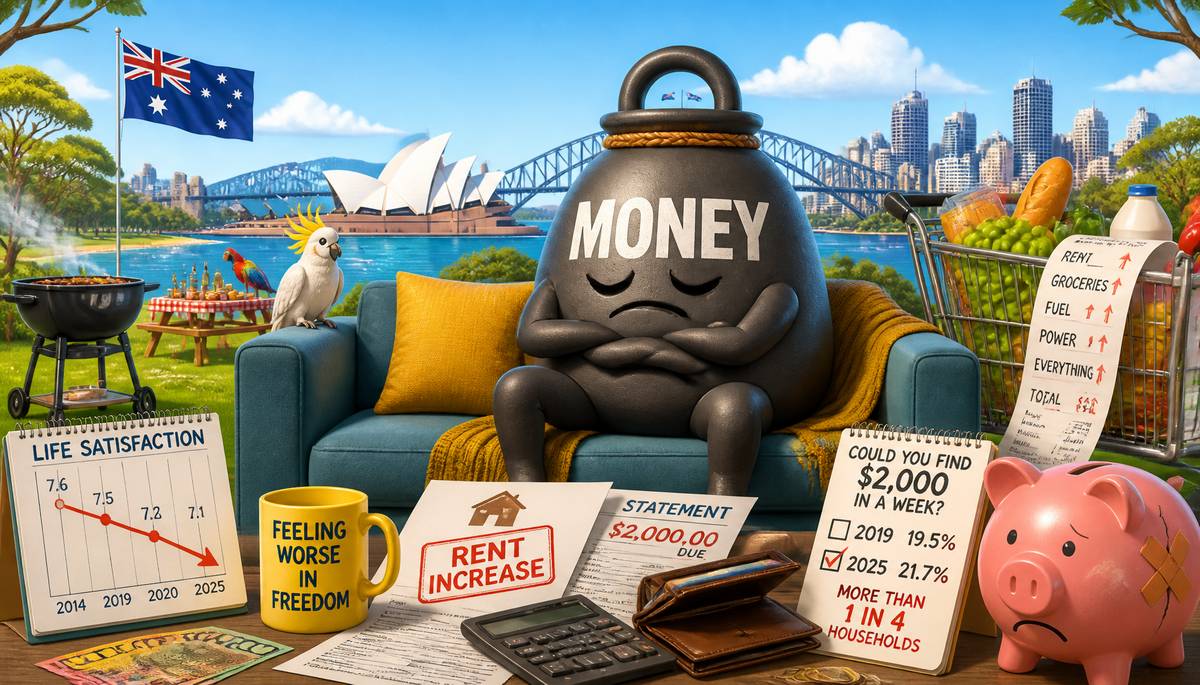
The odd trick of feeling worse in freedom Australians are, on paper, out of lockdown and back among the birds, the barbecues and the alarming price of grapes. Yet many feel less satisfied with life now than they did when movement was rationed and everyone was pretending sourdough was a personality. That sounds upside down until money enters the room, sits heavily on the sofa, and refuses to leave.
New research from KPMG, drawing on Australian Bureau of Statistics data, suggests life satisfaction slipped to 7.1 out of 10 in 2025. That is lower than the 7.2 recorded in 2020, during the first year of the pandemic, and well below 7.5 in 2019. Go back further and the drift becomes clearer still: in 2014, the figure stood at 7.6. Not a collapse, exactly. More a long, dispiriting leak.
The key difference between lockdown misery and present-day misery is duration. Lockdowns were harsh, but many people saw them as temporary. There was a sense, however faint, that normal life would resume after the strange interval of banana bread and masked eye contact. Financial strain is proving less theatrical and more relentless. It does not arrive with daily press conferences. It just keeps turning up in the supermarket, on rent statements, and in the quiet little pause before tapping a card.
Money trouble is proving harder to shake than cabin fever KPMG’s analysis links the drop in wellbeing to worsening household finances. Real wages have gone backwards since 2019, falling by 4.1 per cent by 2025. Household wealth, meanwhile, has largely stalled, with the median sitting at $700,000. That headline number may look substantial, but wealth on paper is not the same as cash in hand, particularly if much of it is tied up in housing while everyday costs keep climbing.
One figure captures the strain rather neatly: 21.7 per cent of households now say they could not find $2,000 within a week if they needed it. In 2019, that figure was 19.5 per cent. It is not a vast leap, but it points in the wrong direction. More than one in four households have also faced at least one cash-flow problem or have relied on stopgap measures such as dipping into savings or taking on more debt. That is not budgeting. That is improvisation with a worried face.
There is one small wrinkle. Fewer households report difficulty paying bills than in 2019, which may reflect energy bill relief measures. Useful, certainly. But a subsidy can lower one pressure point without restoring a broader sense of security. If wages lag, rents bite and savings shrink, people do not suddenly become breezy because the power bill is slightly less murderous.
The pressure is not landing evenly Some groups are carrying much more of it. Single-parent households appear especially exposed, with almost half reporting cash-flow problems. That is the kind of statistic that does not need much embellishment. It already speaks in a tired voice.
Young adults aged 25 to 34 have seen the sharpest decline in life satisfaction, dropping from 7.5 in 2019 to 6.8. They are up against steep rents or heavy mortgages while their earning power has gone backwards in real terms. It is difficult to feel optimistic when every financial milestone seems to move away as you approach it, like a bus that notices you running and gently accelerates.
Australians aged 45 to 54 are not faring brilliantly either, recording 6.9. Many in this bracket are supporting children who are struggling to get ahead while also helping ageing parents. The phrase “sandwich generation” sounds almost jaunty until you remember that being pressed from both sides is the whole point.
There is, oddly enough, one brighter patch. Those aged 15 to 24 have improved from 6.9 during the pandemic to 7.2 now. That does not mean everything is rosy. But it does suggest younger people may be recovering socially and emotionally faster than those carrying mortgages, dependants, or both.
If there is a lesson in the numbers, it is this: freedom of movement matters, but financial stability matters daily. You can leave the house. Marvellous. If each outing costs a fortune and each bill lands like a small threat, the mood sours. Not dramatically. Steadily. Which is often worse.
|
|
